
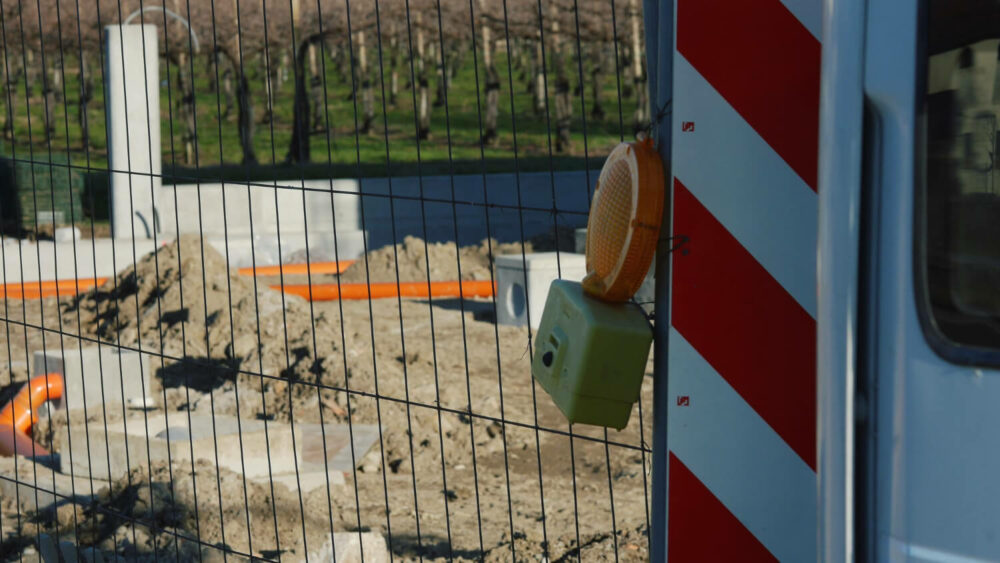
It is the nightmare scenario for every Site Manager: you return from the Christmas break to find the gate wide open, the copper stripped, and your schedule in ruins.
As we approach the December shutdown, the industry focus is rightfully on securing assets. But while you are worrying about CCTV cameras and motion sensors, you might be missing the most glaring weakness in your perimeter defence. It’s not the lock on the gate; it’s the coupler holding the fence panel next to it.
With construction site theft statistics in Australia estimating an annual cost of $650 million to the industry, the “she’ll be right” approach to site lock-up is not a viable strategy.
Here is why your current temporary fencing might be failing you, and the hardware hardening strategy that stops thieves in their tracks.
The Real Cost: It’s Not Just About the Tools
The financial impact of theft is obvious, but the safety impact is often overlooked. Research into construction safety has identified a phenomenon known as the Monday Effect.
Studies show a statistically significant spike in workplace incidents on Mondays compared to any other day of the week. This is often attributed to weekend disruptions (sleep loss, cold start routines, and crucially, changed site conditions).
If a thief enters your site on a Sunday, preventative copper theft construction measures often fail to stop them; they don’t just steal – they disturb. They leave cavities open, scaffolding loosened, and fences unstable. When your crew returns, they are walking into a safety trap. So, securing your perimeter is about asset protection AND ensuring your site is safe for your team to walk onto when the break is over.
The 2-Minute Weakness in Temporary Fencing
Most temporary fencing is hired. It is designed for speed of installation, which unfortunately means it is also designed for speed of removal.
Opportunistic thieves rarely cut through fence fabric; that takes time and creates noise. Instead, they target the couplers. A standard fence coupler is held together by a simple nut and bolt. Any thief with a standard adjustable shifter or a pocket socket set can undo a coupler in less than 10 seconds.
They unbolt two couplers, swing the panel open like a gate, drive a ute in, load up, and drive out. It is silent, fast, and leaves no evidence of forced entry for your insurance claim.
The Hardware Solution: Shear Nuts
The solution is not more cameras; it is better hardware. To turn your temporary fencing from a visual deterrent into a physical barrier, you need to upgrade to temporary fencing security fasteners.
The industry standard for this is the Shear Nut.
How it works: A Shear Nut is a conical nut topped with a hexagonal drive head. You install it using a standard spanner. However, the connection between the hex head and the cone is designed to snap (shear) off once it reaches a specific torque limit.
- Installation: Your team installs the fence as normal.
- The Snap: As they tighten the nut, the hex head snaps off.
- The Result: What remains is a smooth, conical nut that cannot be gripped by pliers, shifters, or spanners.
The Difference in Security:
- Standard Nut: Removal time = 10 seconds (silent).
- Shear Nut: Removal time = 5+ minutes per nut (requires an angle grinder, sparks, and significant noise).
For a thief looking for a quick grab, a fence line secured with shear nuts is an immediate “do not bother.”
Secondary Defence: Hardening the Interior
Once the perimeter is secured, you need to look at the assets inside. Scaffolding components, aluminium signage, and installed fixtures are high-value targets.
If you are leaving scaffolding erected over the break, or if you have expensive signage on hoarding, standard Phillips head screws are a liability. We recommend swapping them out for Prolok security screws.
Prolok security screws (often using a Pin-Hex or Pentaforce drive) require a specialised driver bit to install and remove. A thief carrying a standard multi-tool cannot engage the screw head. It is a low-cost upgrade that makes stripping a site virtually impossible for the average opportunist.
Your 2025 Shutdown Checklist
As you prepare your construction site shutdown checklist for 2025, do not forget the weather. December and January in Australia (especially Queensland) bring severe summer storms.
A loose fence panel can become a projectile.
- Check Wind Loading: Ensure your fencing bracing is sufficient for summer storm gusts.
- Tie Down Formwork: Use heavy-duty structural screw bolts to secure loose ply stacks.
- Remove Shade Cloth: If high winds are forecast, consider slashing or removing shade cloth to reduce the wind sail effect on your fences.
Lock It Down Before You Lock Up
Need it now? We know the pre-Christmas rush is chaotic. That’s why we offer 2-Hour Express Delivery to sites across Brisbane, Gold Coast, and Ipswich.
Don’t let a $2 nut be the reason you lose $20,000 in materials. Lock it down today.